
Featured · Growth capital
How Fast Can a GovTech Company Grow on Its Own Cash?
Slow government pay caps how fast a profitable GovTech company can grow on its own cash. Find your self funded growth rate and fund the difference.
Read the postNotes on growth capital for vertical software companies.
Featured · Growth capital
Slow government pay caps how fast a profitable GovTech company can grow on its own cash. Find your self funded growth rate and fund the difference.
Read the postGrowth capital
Fixed price, time and materials, or cost reimbursement: how each pays on a signed government contract, how much cash it ties up, and how to fund it.
Read the postGrowth capital
Interest is unallowable and fixed prices do not move, so the cost of a slow government receivable is yours. Here is how to plan and fund it.
Read the postGrowth capital
Ten federal agencies count as one customer. Here is how concentration enlarges the cash gap on signed contracts and how to fund each part.
Read the postGrowth capital
A timely bid protest can pause a federal award for up to 100 days. Here is how the pause works and how to fund the gap to your first payment.
Read the postGrowth capital
An IDIQ award only guarantees the minimum. Cash starts with signed task orders. Here is how to plan and fund the gap from award to first payment.
Read the postGrowth capital
Before award, federal contracting officers must find you have the money to perform, or the ability to get it. Here is what they check and how to fund the gap.
Read the postGrowth capital
A bond or letter of credit on a signed government contract can tie up cash before your first invoice. Size it with the payment lag and fund it as timing.
Read the postGrowth capital
A termination for convenience ends remaining work. You may still be paid for work performed, plus demonstrated charges. Size cash to collectible amounts.
Read the postGrowth capital
A stop work order can pause remaining work. It does not, by itself, cancel invoices already accepted. Size cash to amounts still collectible.
Read the postGrowth capital
A lapsed SAM registration can hold a federal payment. Keep the record Active through final payment, then size cash to the invoices that will still be paid.
Read the postGrowth capital
A final invoice can wait while the agency closes the contract file. Those file timelines are not payment due dates. Size cash to a longer last invoice lag.
Read the postGrowth capital
A government payment may be offset or held against a debt. That is not a late invoice. Size cash to what will still be paid, not dollars already applied.
Read the postGrowth capital
A program manager email is not a payable contract change. Invoice extra government work after a written, priced modification, and size cash to signed work.
Read the postGrowth capital
If only part of your government contract is funded, you can generally collect only the allotted or appropriated amount. Size cash to that, not the ceiling.
Read the postGrowth capital
When an agency disputes part of your invoice, some states limit how much it can withhold. Ask for the undisputed portion and fund only the disputed slice.
Read the postGrowth capital
Our math totals about $774B of uncommenced leases across Alphabet, Meta and Oracle. Dates and scopes differ. Learn what the disclosures do and do not mean.
Read the postGrowth capital
Alphabet sold common stock and convertible preferred. Meta's filing shows no common stock offering through September 2026. Compare AI funding sources.
Read the postGrowth capital
A government renewal lapse raises a contract authority question before a cash timing question. Learn what to check before treating gap invoices as due.
Read the postGrowth capital
Signed contracts still need payee registration and often EFT setup before the first invoice can pay. Start at signing and fund only the dated wait.
Read the postGrowth capital
When your invoice is larger than the PO balance, the agency needs a change order to pay the excess. Ask for partial payment and fund only the dated wait.
Read the postGrowth capital
As a subcontractor, your pay date follows the prime's billing cycle and the government's payment. Learn the pass down rules and fund only the dated wait.
Read the postGrowth capital
Many state and local customers pay vendors with grant money they claim back later. Learn the rules that shape your invoice and fund only the dated wait.
Read the postGrowth capital
Many cities and counties approve bills at public meetings. Learn the cutoff, ask about pay before approval, and fund only the dated wait that remains.
Read the postGrowth capital
Federal and state systems show where your invoice sits. Here is how to read each status, what to fix, and how to plan cash around the pay date.
Read the postGrowth capital
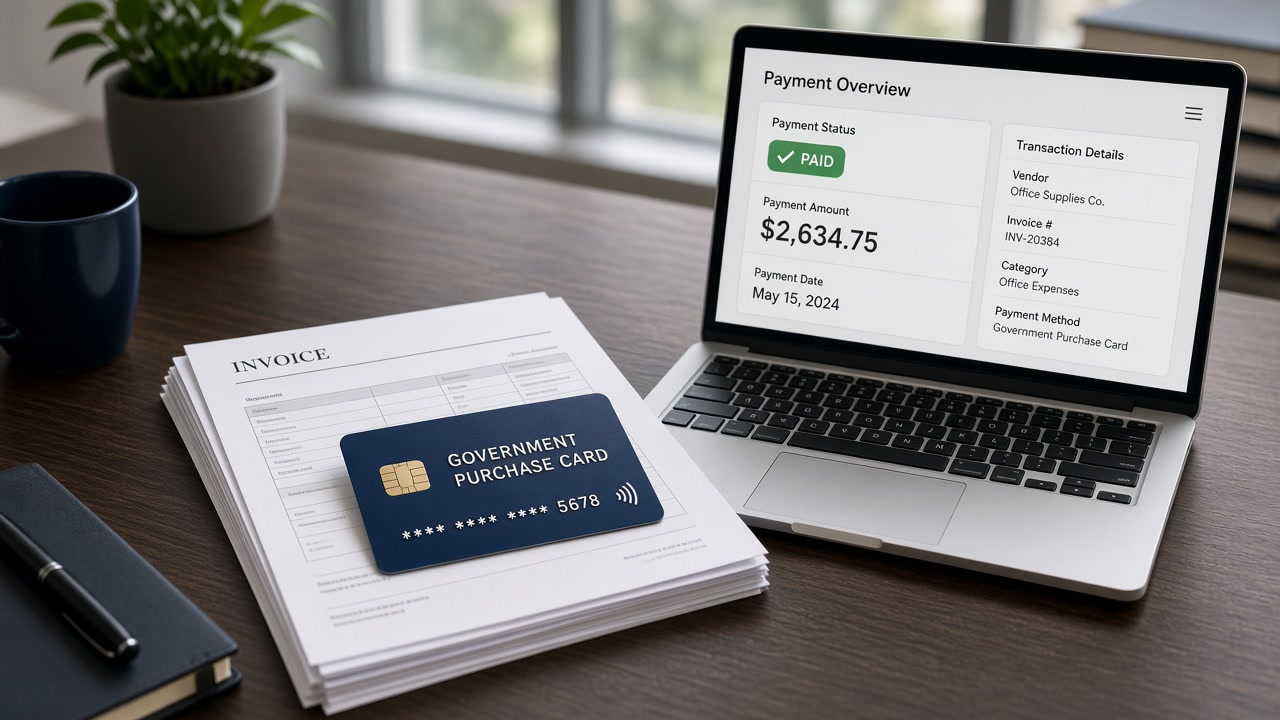
Yes. A government purchase card can pay you right away. Here is when the card fee is worth it, and why big contracts may need a different plan.
Read the postGrowth capital
Map every step from invoice to acceptance to the payment office, see which days you can remove, and finance only the days that remain. For GovTech CEOs.
Read the postGrowth capital
Put a dollar figure on your government contractor cash flow gap, split the permanent base from the peaks, and match each layer to the right kind of capital.
Read the postGrowth capital
Taking $10,000 off a $500,000 invoice to get paid 20 days sooner costs about 36.7% a year. When an early payment discount fits for GovTech software.
Read the postGrowth capital
Working capital bridges slow pay on signed government contracts. Growth capital funds multi year expansion. How GovTech software CEOs choose the right tool.
Read the postGrowth capital
Federal, state, county and city fiscal years for 2027, how continuing resolutions and year end timing affect when agencies pay, and how to plan cash around it.
Read the postGrowth capital
Musk says lenders shut out neoclouds without revenue beyond AI. What SpaceX filed for its $40 billion GPU lease, and what it teaches small software companies.
Read the postGrowth capital
How Meta financed Hyperion: a Blue Owl joint venture, a $27.3 billion bond, a lease back and a value guarantee, and why it sits off Meta's balance sheet.
Read the postGrowth capital
Common stock financing means selling ownership for cash with no loan to repay. When it fits a GovTech software company, and the SEC, SBA and FOCI checks.
Read the postGrowth capital
Capital stack seniority sets who is repaid first at a sale and whose lien comes first on government receivables. Which layer fits which GovTech problem.
Read the postGrowth capital
Revenue based financing repays from a share of revenue. When it fits a GovTech company with slow government payments, and when another tool fits better.
Read the postGrowth capital
How a revolving line of credit works for SaaS companies, how it fits uneven cash flow and slow government payments, and how to plan for renewal.
Read the postGrowth capital
Bullet loan vs amortizing loan: when each one fits a software company, based on the shape of your cash flow and when you expect cash to arrive.
Read the postGrowth capital
Is venture capital right for your startup? Seven signals that VC may be the wrong fit for a vertical SaaS or GovTech company, and what to weigh instead.
Read the postGrowth capital
A software company financing strategy starts with your exit. How VC, loans, revolvers, factoring, revenue based financing, and preferred stock fit.
Read the postGrowth capital
What the Assignment of Claims Act is, how assigning federal contract payments works step by step, and how state and local software contracts differ.
Read the postGrowth capital
Venture debt or venture capital? See which fits your GovTech software company and what each one asks you to give up.
Read the postGrowth capital
In the government software contracts we reviewed, implementation is paid by accepted milestone minus a holdback. See real contract examples and what you can negotiate.
Read the postGrowth capital
Federal GSA guidance says upfront annual SaaS payment is not a prohibited advance payment. Here is what federal, state, and local rules allow and how to ask.
Read the postGrowth capital
How the federal Prompt Payment Act and state laws in Minnesota, Virginia, New Jersey, Florida and Texas treat late payment to software vendors, what interest you can claim, and how to bridge the gap.
Read the postGrowth capital
For GovTech and SLED software vendors with signed contracts and slow payments: compare early payment, factoring, credit lines, and contract-backed capital.
Read the postTell us where you are. We read every note and reply to founders directly.
Get In Touch